Inspiring Healing Through the Power of Human-Animal Connection
This program has been approved by the Private Training Institutions Regulatory Unit (PTIRU) of the British Columbia Ministry of Post-Secondary Education and Future Skills.
The Professional Animal-Assisted Wellness Therapy Diploma (PAAW) at Rhodes Wellness College is a experiential program that trains individuals to ethically and skillfully integrate animals into therapeutic and coaching practices. As the first program of its kind offered by a private college in British Columbia, it merges the richness of trauma-informed care, coaching psychology, ethology, and mindfulness to create a powerful modality for wellness and healing.
Carla Webb, BA, Pro-EFW M,Ed in progress, Trainer, Coach, Mentor, Facilitator, Rhodes Faculty
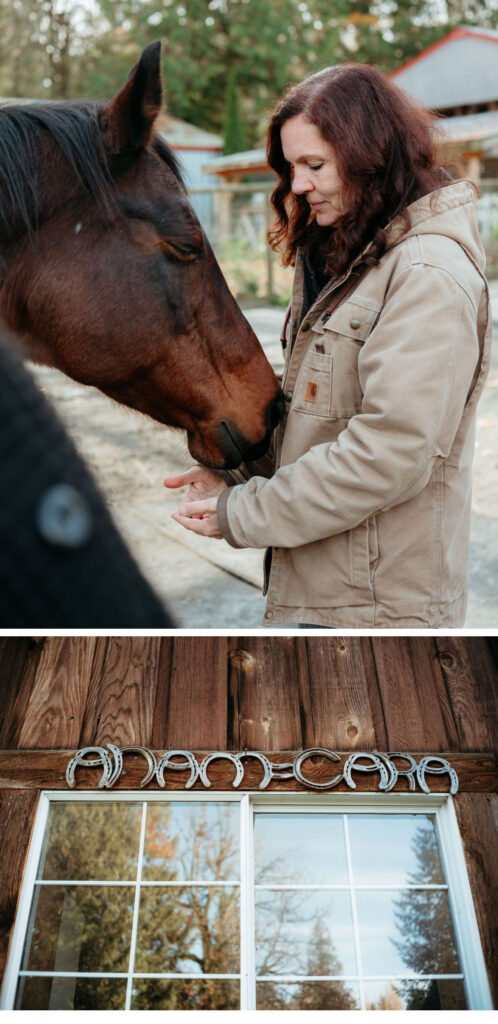
Carla Webb is an Equine Facilitated Learning Professional, Equine Professional, Pro-EFW Mentor (Professional Association for Equine Facilitated Wellness) and Life & Wellness Coach. She is currently working on her M.Ed in Humane Education at Antioch University and designed the professional Animal Assisted training program for Rhodes Wellness College. A believer in lifelong learning, Carla is also studying with Equusoma (Horse-Human Trauma Recovery)
While Carla has partnered with horses for over 40 years, she has also built strong relationships based on choice, consent and ethical considerations with donkeys, pigs, sheep and chickens. It is her belief that all animals are sentient beings and as such deserve the utmost in care and respect. Carla is exceptional at creating safe spaces for her clients and animal partners. She understands the healing nature of attunement and works hard to foster respectful relationships between humans and the natural world.
After sixteen years of full-time client practice Carla is currently focusing on teaching, mentoring and consulting the next generation of Animal Assisted, Nature-Based and Equine Facilitated Wellness professionals. She has collaborated with Honour Ranch, Rhodes Wellness College and the University of Fraser Valley, and multiple social service agencies such as Mission Hospice, Abbotsford Hospice, PCRS Traverse and Surrey Schools Carla lives in Abbotsford at Anam Cara Farm and Learning Center with her life partner, Steve, five horses, two miniature horses, two miniature donkeys, three sheep, five pigs, five chickens, two dogs, and two cats.
The program begins with the Life Skills Coach Certificate program to ensure students have a solid foundation of being an empathic coach and facilitator. This is followed by three semesters focused on animal-assisted wellness and care, beginning with a brief history of animal-human partnerships and the current research on animal-assisted wellness practices. The program continues with experiential instruction that will enable students to partner with animals safely and ethically in both private and group settings. By learning about animal consent and stress signals, coupled with relational practices and trauma-sensitive care, this program provides students with the necessary skills to work with animals to assist in fostering wellness.
Program Overview
This program is for individuals inspired to work together with animals to promote human wellness, or those already in a helping profession who desire to expand their repertoire of modalities of supporting others. Professional Animal-Assisted Wellness (PAAW) graduates are prepared to start their own private practice, partner with organizations, or augment their established helping profession with animal-assisted therapy. This program provides a strong foundation for all students by starting with an entire semester in coaching, after which students are eligible to pursue the designation of Associate Certified Coach (ACC) with the International Coaching Federation (ICF).
Rooted in relationship-centered coaching, the program equips students with essential competencies such as empathic listening, mindful presence, and creative problem-solving. Students will also explore the cultural and historical context of human-animal relationships, including the impact of colonization, to deepen their understanding of how perceptions of animals have evolved. With a strong foundation in somatic awareness, students will assess nervous system responses and behavioral patterns in both clients and animal partners, using this insight to support regulation, adaptability, and healing. The program includes training in ethical animal care, ethological research, and the development of personalized wellness plans for animal partners. Graduates will be prepared to navigate mental health challenges using a biopsychosocial framework and adapt sessions to meet diverse client needs.
Throughout the program, students engage with current research on biophilia and the therapeutic power of the human-animal bond, developing the language and confidence to represent the field with integrity, professionalism, and care. Ultimately, they will be well-positioned to support healing and transformation through respectful, intentional partnerships between humans and animals.
This program includes a two-week, full-time residency in which students participate in fully facilitated, immersive, in-person classes. Prior to the residency, students complete two weeks of introductory online instruction designed to prepare them for the final phase of the course. The residency takes place at a dedicated facility and features on-site learning in a safe, respectful environment alongside the animal partners of animal-assisted wellness therapy facilitators. Click here to view photos of the farm where the two-week residency takes place.
Graduate Outcomes
Graduates of the Professional Animal-Assisted Wellness Therapy Diploma program will be equipped with the knowledge, skills, and confidence to pursue diverse career pathways in the growing field of animal-assisted wellness. With a strong foundation in trauma-informed, client-centered, and animal-centered care, graduates are prepared to ethically and effectively integrate animals into therapeutic, educational, and coaching environments. Career opportunities include working as an Animal-Assisted Wellness Therapist, Coach, Educator, or Activities Facilitator, and in roles involving animal-assisted intervention or therapy. Many graduates go on to establish their own private practice or wellness business, while others choose to collaborate with established organizations in health care, education, or community services.
Ready to Apply?
Are you interested in becoming a student at Rhodes Wellness College? Click on the Apply Online link below to get started! Here you’ll find all the admission requirements and all the important links for starting your application.
| Total Program Length | 52 weeks (1,261 hrs) |
| Number of Semesters | 4 |
| Tuition per Semester | $3,650.00 |
| Total Tuition | $18,250.00 |
| Application Fee (Domestic) | $100 (non-refundable) |
| Application Fee (International) | $500 (non-refundable) |
| Course Material Fee* | $250 |
| Archive Fee* | $100 |
| Other Fees* | $815 |
| Delivery Method | Online with a two week residency |
| Language | English |
| Next Intake | Jan 4th, 2027 – Jan 28th, 2028 |
| Schedule | Monday to Friday, 9 am to 1:30 pm PST |
*For a complete breakdown of each cost category, please see the dropdown menu below.
Course Material Fee*
A variety of materials including e-books, articles, readings, course notes, and other resources will be utilized to support each course. Specific suggestions are detailed in the program outline here.
Student Activity Fee*
This program includes a student activity fee which includes career planning events, tutoring, all student drop-in sessions, student services info sessions, all student assembles, coaching & counselling labs, virtual cafes, speaker series and all workshops.
Archive Fee*
In compliance with PTIRU bylaws, each student’s enrolment contract, transcript and diploma or certificate will be stored with Datawitness for a period of no less than 25 years, retrievable only by Rhodes Wellness College administrative staff.
Other Fees*
This program includes a Student Activities fee of $300, which supports participation in student events, activities, and community-building initiatives. There is also a Residency Fee of $415, classified by StudentAid BC as a Field Trip fee, which covers costs associated with required residency components of the program. Additionally, a combined Equipment Usage, Technology Usage, Graduation, and Transcript fee of $100 provides access to essential equipment and technology, and includes one official copy of the student’s transcripts and one official copy of the diploma or certificate earned.
Admissions Requirements for the Professional Animal-Assisted Wellness Therapy Diploma program
Rhodes Wellness College is committed to enrolling students who meet program admission criteria and who are capable of achieving their education and career goals. For admission to Rhodes Wellness College’s Professional Animal-Assisted Wellness Therapy Diploma program, an applicant must meet the following criteria:
- Reach the age of majority (19 years old in British Columbia) or provide to the College the written consent from the applicant’s parent/guardian.
- Submit a Personal Statement on why the applicant desires to pursue a PAAW Therapy Diploma at Rhodes Wellness College.
- Successfully complete an Admissions interview.
- Share one’s experience and level of comfort with animals during the interview. The College may require the applicant to provide a letter of reference, confirming the applicant’s comfort and potential to work with animals.
- If an applicant has had an addiction to drugs or alcohol, a minimum of 12 months prior sobriety is required to be verified during the interview. The College may require the applicant to provide a letter from a counsellor, confirming the applicant’s sobriety.
- Meet the program’s Language Proficiency requirement.
Rhodes Wellness College reserves the right to deny any candidate admission into this program if Admissions does not believe the applicant will be a potential fit or adequately benefit from taking the program.
Language Requirements
All students, whether they be Canadian or International students, must prove sufficient English proficiency through one of the following methods:- Evidence that 3 years of full-time secondary education (Grades 8-12), or 2 years if the Grades are 10, 11, or 12, have been successfully completed in the program’s language of instruction in a country where the language of instruction is one of the principal languages. This may be demonstrated by providing a high school transcript, completion of a BC Adult Graduation program or providing international education credentials recognized through WES, ICES, or IQAS.
- Two years of full-time post-secondary education* have been completed in the program’s language of instruction in a country where the language of instruction is one of the principal languages (includes international education credentials recognized through WES, ICES, and IQAS).*Language development courses (i.e., ELL courses) cannot be included in this
- Successful completion of one of the following English proficiency exams, achieving the minimum required score indicated below:
a. International English Language Testing System (IELTS) Academic: Minimum overall score of 5.5
b. Test of English as a Foreign Language (TOEFL) IBT: Minimum overall score of 46
c. Canadian Academic English Language Assessment (CAEL): Minimum overall score of 40
d. Canadian English Language Proficiency Index Program (CELPIP): Listening 6, Speaking 6, Reading 5, and Writing 5
e. Duolingo English Test (DET): Minimum overall score of 95
f. Pearson Test of English (PTE) Academic: Minimum overall score of 43
g. Cambridge English Qualifications: B2 First exam (FCE): Minimum overall score of 160 or “C” (Institutions may include other Cambridge Qualifications at a higher level, e.g., C2 Proficiency (CPE))
h. Cambridge Linguaskill: Minimum overall B2 level
i. LANGUAGECERT Academic: Minimum overall B2 level
j. The Michigan English Test (MET): Minimum overall B2 level
k. iTEP Academic: Minimum overall score of 5
l. EIKEN: Minimum placement of Grade Pre-1
- Where the applicant is 19 years of age or older at the start of the program and is a Canadian citizen or permanent resident, and the applicant cannot access their educational records or cannot provide sufficient evidence of secondary or post-secondary education through one of the other stipulated methods in the College’s Language Proficiency Policy, they may satisfy language proficiency requirements through the Accuplacer English Assessment process as follows:
- Applicant provides attestation that they have completed at least three years of full-time instruction in English in a country where the English is one of the principal languages*, and
- Applicant completes an Accuplacer English Assessment (Next Generation: Reading, Writing and WritePlacer) and achieves the following minimum scores:
i. Reading: 230, and
ii. Writing: 230, and
iii. WritePlacer: 4
*Language development courses (i.e., ELL courses) cannot be included in this calculation. Accuplacer may not be used to demonstrate that a student meets an admission requirement other than Language Proficiency.
*English-speaking countries include the following:
|
|
|
For a comprehensive and detailed explanation of our policies, please visit the following pages:
- Refund Policy
- General Admissions Policy
- Language Proficiency Assessment Policy
- Attendance Policy
- Student Statement of Rights
- Dismissal and Student Code of Conduct Policy
- Dispute Resolution Policy
- Sexual Misconduct Policy
- Work Experience Policy (“Practicum”)
- Other Policies